
How Can I Make My Mortgage Payment More Affordable? 8 Ways in Ventura County

You can qualify for a home loan and still find the monthly payment is more than you are used to. That is normal at the start. Here are the ways to bring it down: what you control before you buy, and the tools that make owning a home more affordable each month.
Quick answer: Start with the loan itself: shop below the top of your pre-approval, work on your credit score, and ask for a seller-paid 2-1 buydown, discount points or a first-time buyer program. Then look at the other pieces of the payment: 20 percent down drops the mortgage insurance, and property taxes, Mello-Roos, HOA dues and insurance vary from home to home. Last, if you have the assets, pay off other debts so the mortgage is the main bill you carry.
What makes up your monthly mortgage payment?
Most buyers think the payment is just the loan. It is usually five pieces:
- Principal and interest: the loan itself, plus the interest.
- Property taxes: collected monthly by the lender.
- Homeowners insurance: also collected monthly on most loans.
- Mortgage insurance: on conventional loans with less than 20 percent down, and on FHA loans.
- HOA dues: common with condos and townhomes.
The following tips go over how you can make your monthly payment more manageable, grouped by the piece they lower.
Lower the loan itself: principal and interest
Principal and interest is the biggest piece. The price you buy at, your credit score and the tools in the deal all move it.
1. Do I have to buy at the top of my pre-approval?
No. Your pre-approval is a ceiling, not a target. If you are approved for a $900,000 purchase, you do not have to buy at $900,000. Tell the lender the monthly payment you are comfortable with, and they can work backward from it to the price range you should be shopping in.
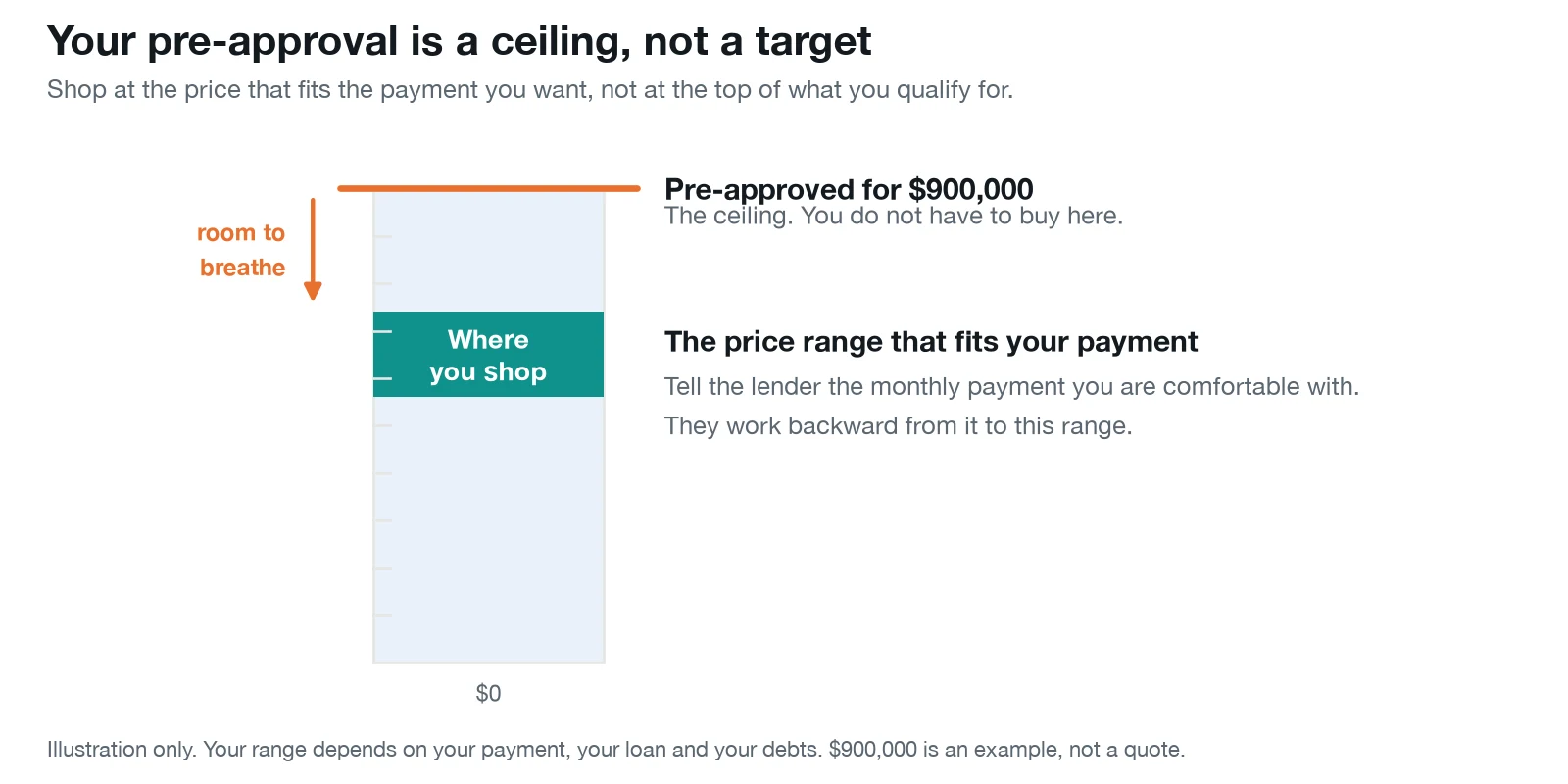
Your pre-approval is a ceiling, not a target. Illustration only; $900,000 is an example, not a quote.
I tell a lot of my first-time buyers that the first home is not always the forever home. Starting with a more manageable payment, often a condo or townhome, lets you build equity and move up five or seven years later. To see what that range looks like right now, browse by city:
Condos: Oxnard, Ventura, Camarillo, Port Hueneme, Simi Valley, Thousand Oaks, Moorpark, Santa Paula.
Townhomes: Oxnard, Ventura, Camarillo, Port Hueneme, Simi Valley, Thousand Oaks, Moorpark.
One catch: a condo or townhome usually comes with HOA dues, and those count in your payment. Compare the full monthly cost, not just the price.
2. Does a better credit score lower my mortgage payment?
It can. Your credit score affects the pricing a lender offers you, and on a conventional loan, Fannie Mae’s pricing chart adds charges at lower scores. Small things move a score: paying every bill on time, keeping card balances well below their limits, and not opening new credit before you buy. My pre-approval guide covers credit scores in more depth.
Should you buy now or wait to fix your credit? People fall into two buckets.
- You want to buy now, but something is holding you back for a while. Maybe a lease you cannot get out of, a transfer to a new location, or anything else that keeps you from making the move today. If that is you, my recommendation is to use that time to significantly improve your credit score. You are waiting either way.
- You could buy now, and you are choosing to wait. My recommendation is to speak to a lender now and get a quote. A better score can get you better pricing, but nobody knows if waiting will pay off. Rates can go up in six months, or down. If they go up, that can wipe out what the better score would have saved you.
Either way, ask the lender two questions. What would my loan look like today, with the score I have? And how much would my score need to go up to get better pricing? Pricing changes at certain score levels, so a few more points might make a real difference, or none at all. Compare the two answers, then decide.
3. How does a 2-1 buydown lower my interest rate for the first two years?
A 2-1 buydown is a tool that makes your monthly payment more affordable for the first two years of the loan. Money paid at closing lowers your interest rate in years one and two, and your payment steps up to the full amount in year three. Here is the easy math.
| Year of the loan | Your payment is figured at |
|---|---|
| Year 1 | your note rate minus 2 percentage points |
| Year 2 | your note rate minus 1 percentage point |
| Year 3 and after | your full note rate |
How a 2-1 buydown steps up. Your actual rate and payment come from your lender’s quote.
Helpful note
What a “note rate” is
The note rate is the interest rate written into your loan papers. It is the rate you pay once any temporary buydown ends.
Those two years matter more than people think. New homeowners sometimes do not realize the hidden expenses that come with a new property: a few repairs, some work, an upgrade or two. A lower payment in the first two years can help greatly with those unexpected costs.
Who pays for it? In a buyer’s market, meaning homes are sitting on the market a long time, buyers have more negotiating power than sellers. So if a home has been sitting, in some cases I can negotiate for the seller to pay for the 2-1 buydown. That is a much better incentive for you than a price reduction. A small price cut barely moves your payment, while the same money in a buydown lowers it noticeably for two years. The lender quotes what it costs on your loan, and the seller’s credit can go toward the buydown or your closing costs, within your loan program’s limits. More in my post on how a 2-1 buydown works in Ventura County.
The part that protects you: on Fannie Mae and FHA loans, the lender qualifies you at the full note rate, not the bought-down rate. The year-three payment is one you already qualified for.
4. Should I pay discount points to lower my rate for good?
Sometimes. Discount points are money paid at closing to lower your interest rate for as long as you keep a fixed-rate loan. They are the permanent version of a buydown, and the seller can pay for them too.
The real question is how long you will keep the loan. Points cost money up front, and the monthly savings pay that back slowly. If you plan to stay a long time, points can make sense. If you might sell or refinance in a few years, a temporary buydown may be the better use of the money. A lender can show you the break-even point on your numbers.
5. Are there programs that make the payment cheaper for first-time buyers?
Yes. On conventional loans sold to Fannie Mae, Fannie Mae waives its pricing charges for first-time buyers under its income limits, which can mean a lower rate. Other programs help with the down payment, often through a deferred second loan that is paid back when you sell or refinance. My guide on who counts as a first-time home buyer explains who qualifies, and it is broader than most people think.
Drop the mortgage insurance
6. How does a bigger down payment or dropping PMI lower my payment?
A bigger down payment means you borrow less, and on a conventional loan you can skip mortgage insurance at 20 percent down. The mortgage insurance payment goes away, which removes one of the five pieces of your monthly payment.
You do not need 20 percent to buy, though, and I understand that not everyone has that much sitting around. In my experience, most buyers do not put 20 percent down on their first home. Most eligible buyers put 3.5 percent down with an FHA loan or 5 percent down with a conventional loan. A good lender will present you with the options so you can make an informed decision. My post on whether you need 20 percent down walks through the trade-offs.
If you put less down on a conventional loan, the private mortgage insurance (PMI) does not stay forever. You can ask your servicer to cancel PMI (private mortgage insurance) once your balance is scheduled to reach 80 percent of the home’s original value, and it ends automatically at the scheduled 78 percent mark if you are current on payments.
Check the other pieces: taxes, HOA and insurance
7. What else adds to your monthly cost of owning a home?
Your monthly cost of owning a home is more than the loan. Other things to consider:
- Property taxes are based on the purchase price of the property.
- Mello-Roos. Some newer neighborhoods carry extra taxes, such as Mello-Roos, on top of the regular property tax. RiverPark in Oxnard is one place I see it. Two homes at the same price can have different payments because of them, so I make sure you know whether a home has Mello-Roos before you make an offer.
- Shop your homeowners insurance. Quotes vary between companies, so get them early. Start with whoever insures your car now: many companies give a discount when you bundle home and auto, so ask if they have a deal. Then ask your lender to help you find the best policy. Most lenders will, because a lower insurance payment also helps your qualifying and your buying power.
Beyond the mortgage: your other monthly bills
This last one is not part of the mortgage payment at all, but it decides whether the house payment feels manageable.
8. Should I pay off other debts before buying a house?
Sometimes, if you have the assets, it is worth paying off other liabilities such as a car loan, credit cards or similar debts to help with your overall monthly bills. It does not lower the mortgage payment itself. It lowers everything else leaving your account each month, so the mortgage becomes the main bill you focus on. It also improves your debt-to-income ratio.
Helpful note
What “debt-to-income ratio” (DTI) means
Debt-to-income ratio (DTI) is your monthly debt payments, including the new house payment, divided by your monthly income before taxes. Lenders use DTI (debt-to-income ratio) to decide how much payment you can handle.
Here is a real example. I worked with a buyer who was very careful about her monthly payment. She had good savings, but she also had a car payment and some credit cards. In her head, she was stacking all of that on top of the new house payment.
She could have put that extra cash into a bigger down payment. But that would have lowered her house payment by only a fraction. Paying off the car and the cards took whole payments off her plate every month. That gave her the breathing room she wanted, because her income could go toward the home. Once she saw it that way, she got comfortable with the payment and made the move.
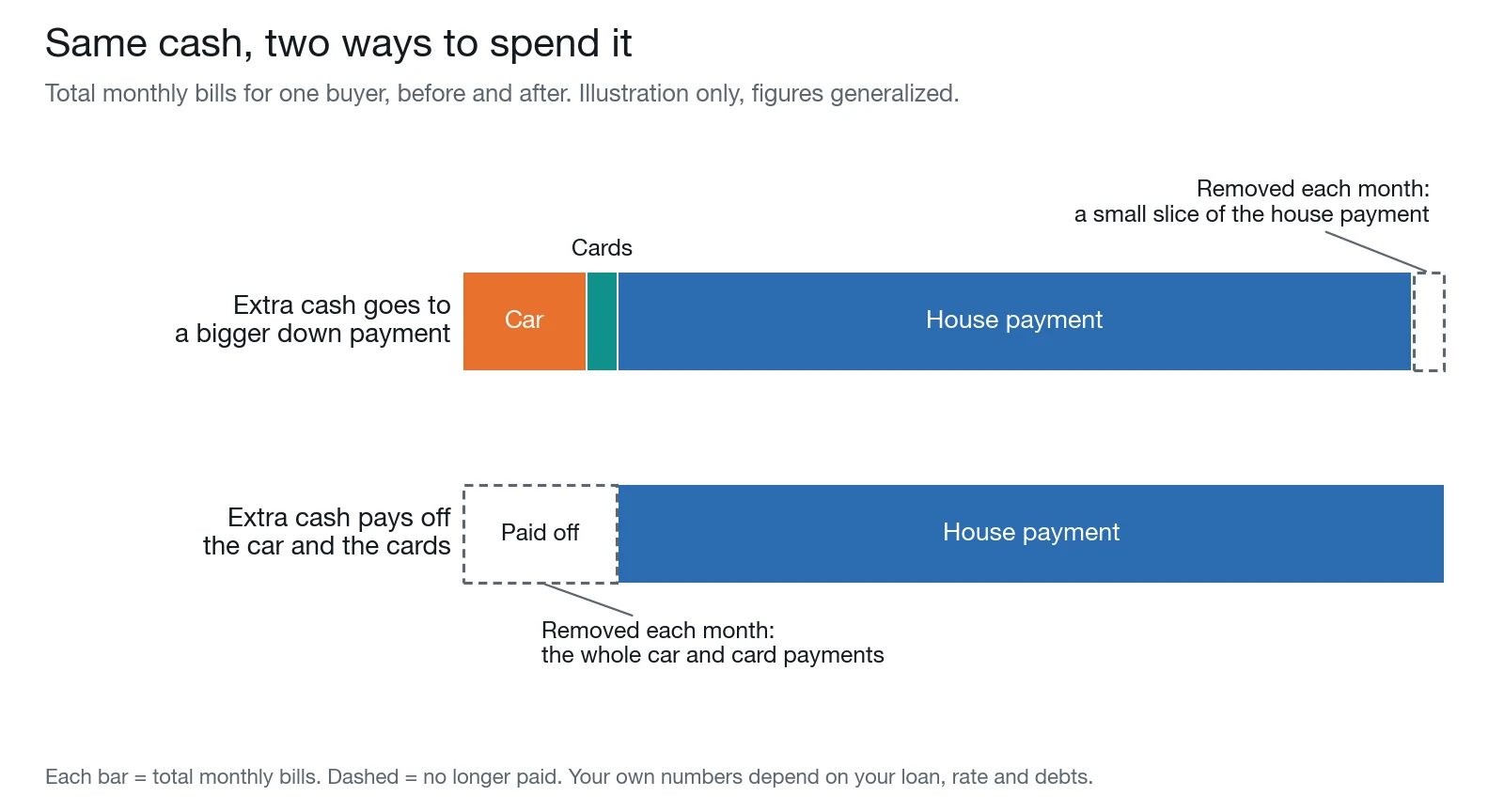
Same cash, two ways to spend it. An illustration with generalized figures; your own numbers depend on your loan, your rate and your debts.
Talk to the lender before you write the check. Cash you use to pay off debt is cash you no longer have for your down payment, closing costs or reserves. Because I am a licensed loan officer as well as a Realtor, I look at that trade-off with you before you move any money, and my lending team confirms what counts.
The honest summary
The buyers who get the best result stack several of these. Pick a price that fits, not the top of your pre-approval. Work on your score. Then use the deal: a seller credit toward a buydown, points if you are staying, and any program you qualify for. Check the mortgage insurance, the taxes, the HOA and the insurance on every home. And pay off small debts if the cash allows, so the house payment is the main bill you carry.
The right mix depends on your income, your debts and the home. That is where someone who knows both the house side and the loan side can save you time and money. I also write your offer with contingencies for inspection, appraisal and your loan, so you may be able to cancel inside those periods and get your deposit back under the contract’s terms. Contingencies depend on the contract you negotiate.
If you want to see which of these fit you, contact me or start with the Buying page. Hablo español.
Common questions
How can I lower my mortgage payment before I buy a house?
You can lower your mortgage payment before you buy by choosing a price below the top of your pre-approval, such as a starter home or condo, and raising your credit score. Inside the deal, a seller-paid 2-1 buydown, discount points, a first-time buyer program or a larger down payment can lower it further. Paying off other debts lowers your total monthly bills, not the mortgage itself.
What is a 2-1 buydown?
A 2-1 buydown is a temporary rate reduction where the payment is figured two percentage points below the note rate in year one and one point below in year two. From year three on, you pay the full note rate. The seller can pay for it at closing as a seller credit.
Do I qualify at the lower payment with a buydown?
No, with a temporary buydown the lender qualifies you at the full note rate, not the bought-down rate. Fannie Mae and FHA both require this. So the year-three payment is the payment you already qualified for, and the buydown does not increase how much you can borrow.
Should I pay off debt before buying a house?
Paying off debt before buying a house often helps, because it lowers your monthly bills and your debt-to-income ratio. Talk to the lender first, though. Cash used to pay off debt is not available for your down payment, closing costs or reserves, and the trade-off depends on your numbers.
When does PMI go away on a conventional loan?
On a conventional loan, you can ask to cancel PMI once your balance is scheduled to reach 80 percent of the home’s original value. It ends automatically when the balance is scheduled to reach 78 percent, as long as you are current on your payments. Ask your servicer for the date.
Will my property taxes be the same as the seller’s?
Usually not, because California reassesses a home at its current market value when it sells, so your property tax is based on what you pay. A seller who bought years ago may pay much less, so budget from your own purchase price.
Sources
- Fannie Mae: Selling Guide B2-1.4-04, Temporary Interest Rate Buydowns, August 7, 2024
- Fannie Mae: Loan-Level Price Adjustment Matrix, September 30, 2026
- FHA (HUD): Single Family Housing Policy Handbook 4000.1, temporary interest rate buydowns, August 12, 2026
- Consumer Financial Protection Bureau: When can I remove private mortgage insurance (PMI) from my loan?
- California State Board of Equalization: Change in Ownership FAQs
This post is general information, not a loan commitment, not an offer to lend, and not legal, tax or financial advice. Loan programs and their requirements are applied by the lender to each individual file, and every file is different. Temporary buydowns, discount points and seller credits are not available on every loan program, and their terms, eligibility and contribution limits vary by lender and program. All loans are subject to credit approval, eligibility, appraisal and property requirements. There is no guarantee of rate, term or approval, and guidelines can change without notice. Speak with a licensed loan officer about your situation. Edgar Limon, REALTOR, CA DRE #02225743, CENTURY 21 Masters, CA DRE #01849354. Each office is independently owned and operated. Mortgage loan originator, NMLS #2256286, with 21st Century Lending, NMLS #241835, a division of Full Realty Services, Inc. Licensed by the Department of Financial Protection and Innovation under the California Residential Mortgage Lending Act and California Financing Law. Loans made or arranged pursuant to a California Financing Law license. Verify licenses at NMLS Consumer Access. Century 21 Masters and 21st Century Lending are affiliated companies. You are not required to use 21st Century Lending, or any particular lender, as a condition of working with me. I am not affiliated with or endorsed by any government agency. Equal Housing Opportunity. Equal Housing Lender.
Filed under
Tags
Share this article
Written by