
4 Things to Know After You Talk to a Lender in Ventura County

You filled out the loan application, sent your documents, and got a pre-approval letter back. Before you shop for a home in Ventura County, make sure you can answer four questions about that letter. I am a Realtor and a licensed mortgage loan originator, and I often meet buyers who already have a lender but cannot answer these yet. That is normal, and it is easy to fix.
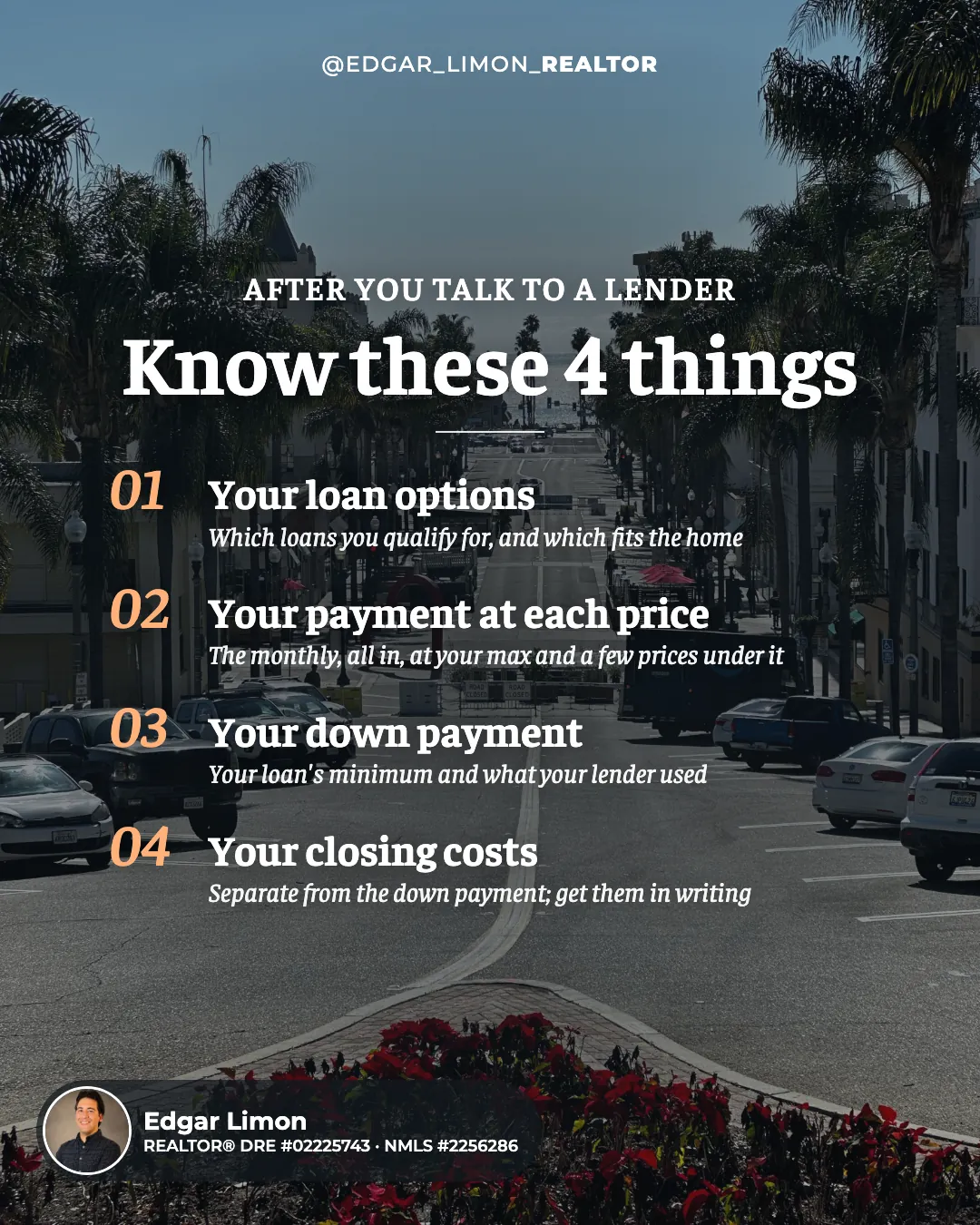
Quick answer: After you talk to a lender and get pre-approved, know four things: your loan options, your monthly payment at a few prices under your maximum, your down payment, and your closing costs. If you cannot answer one, ask your lender before you make offers.
If you have not talked to a lender yet, start with the four questions to answer before you talk to a lender.
1. What are your loan options?
Ask which loans you qualify for, not just which one your lender picked. Ask what you can compare and what the pros and cons are. If they qualified you on FHA, ask about conventional, or VA if you are an eligible veteran or service member.
It matters because the home can rule a loan out. Not every condo works with FHA: under FHA Handbook 4000.1, FHA insures units in approved condo projects. If you are shopping condos in Oxnard and the complex you love is not approved, a conventional loan may keep you in the game. Each option also has its own buying power and down payment. More in my conventional, FHA and VA comparison.
2. What is your monthly payment at each price?
Know whether your pre-approval is your maximum or a number you are comfortable with. Some lenders approve you up to the ceiling, and the payment there can put you in a tight spot. So ask for a range. Say you are pre-approved for $700,000. Ask for the monthly payment, all in (loan, property tax, insurance and any HOA dues), at $700,000, $650,000 and $600,000.
| Price you might pay | Minimum FHA down payment at 3.5 percent | Monthly payment, all in |
|---|---|---|
| $700,000 (your maximum, in this example) | $24,500 | Ask your lender |
| $650,000 | $22,750 | Ask your lender |
| $600,000 | $21,000 | Ask your lender |
Example only. FHA’s 3.5 percent minimum applies to eligible buyers with a credit score of 580 or higher, figured on the lower of the price or the appraised value (FHA Handbook 4000.1).
What I tell my clients: look at the monthly at your highest pre-approval, then tell the lender what you are comfortable paying, and they will give you a second price. Shop in the spread between the two. Maybe you are totally comfortable $50,000 under your maximum. Now you decide, not the letter.
3. How much is your down payment?
Know the minimum your loan requires and the amount your lender actually used. Minimums for eligible buyers:
- FHA: 3.5 percent with a credit score of 580 or higher; 10 percent between 500 and 579.
- Conventional: as little as 3 percent on some programs, such as Fannie Mae’s HomeReady or a standard loan with a first-time buyer (not on high-balance loans).
- VA: its own rules for eligible veterans and service members. Ask your lender.
Then ask: “Is this the minimum? Can I put down more, or less?” Some lenders use the minimum; some use more because you asked for a lower monthly payment. More down means a smaller loan and a lower payment. Less down keeps more in savings. Either way, know which one you picked. More in do you need 20 percent down.
4. How much will your closing costs be?
Get your closing costs in writing before you commit. I have heard horror stories of buyers who show up to sign and learn they owe thousands in closing costs on top of the down payment. It has never happened to me, but buyers have told me, “Edgar, I want to buy, but I am scared, because this happened to me before.” That should not happen to anyone.
Closing costs are separate from the down payment: lender fees, the appraisal, escrow, title, and prepaid items like your first year of homeowners insurance. Once you give your lender a property address with the rest of your application, federal rules (Regulation Z, 12 CFR 1026.19) require a Loan Estimate by the third business day. Before you have an address, ask for a written estimate at the price you plan to shop at.
Helpful note
The Loan Estimate and the Closing Disclosure
The Loan Estimate is a standard form showing your estimated closing costs and cash to close, the money you bring on closing day. The Closing Disclosure is the final version, due at least three business days before closing. Compare the two and ask about anything that changed.
Closing costs can sometimes be negotiated. On a home that has sat on the market, I can ask the seller to help, though it is never guaranteed. On an FHA loan, the seller and other interested parties can contribute up to 6 percent of the sales price. More in the closing costs guide.
The short version
Know your loan options, your monthly at a few prices, your down payment and your closing costs. Shop in the spread between your maximum and your comfortable number, and get costs in writing early. Many loan questions land in a gray area, and because I know both sides, I look at whether your loan fits the homes you want. If you want a second opinion on what your lender gave you, that is a smart move; you are free to choose any lender. Send me a message, or answer the quick questions below for a free starter guide. When you make an offer, I write in contingencies for the inspection, the appraisal and the loan, so you can cancel inside the contingency period and keep your deposit; the details depend on the contract you negotiate.
Common questions
How long does mortgage approval take after pre-approval?
Final approval usually comes during escrow, after your offer is accepted, which commonly runs 21 to 45 days. In that time the lender orders the appraisal and reviews your file again, and you get the Closing Disclosure at least three business days before closing.
Should I buy at my maximum pre-approval amount?
You do not have to, and many buyers should not. Your maximum is the most a lender will lend, not the payment you will be comfortable with. Ask for the monthly payment at your maximum and at a few lower prices, then shop where it fits your budget.
When do I get a Loan Estimate?
Your lender must deliver it by the third business day after receiving your application, which under the federal rule includes a property address. Before you have an address, ask your lender for a written estimate of closing costs at the price you plan to shop at.
Are closing costs included in the down payment?
No, the down payment and closing costs are two separate amounts. The down payment is your share of the price. Closing costs are the lender, appraisal, escrow, title and prepaid charges that make the sale close. Your Loan Estimate shows both.
Can I put more down than the minimum?
Yes, the minimum is the least your loan program requires, not the most you can put down. More down means a smaller loan and a lower monthly payment; less down keeps more in savings. Ask your lender to show you both.
Sources
- FHA (HUD): Single Family Housing Policy Handbook 4000.1, last revised August 12, 2026
- Fannie Mae: Selling Guide B2-1.3-01, Purchase Transactions, published October 7, 2026
- Fannie Mae: HomeReady Mortgage
- CFPB: Regulation Z, 12 CFR 1026.19 and 12 CFR 1026.2
- CFPB: Loan Estimate, last modified October 29, 2025
- CFPB: Closing Disclosure, last modified October 10, 2023
This post is general information, not a commitment to lend, not an offer to lend, and not legal or tax advice. Loan programs and their requirements are applied by the lender to each individual file, and every file is different. All loans are subject to credit approval, eligibility, appraisal and property requirements. There is no guarantee of rate, term or approval, and guidelines can change without notice. Speak with a licensed loan officer about your situation. Edgar Limon, REALTOR, CA DRE #02225743, CENTURY 21 Masters, CA DRE #01849354. Each office is independently owned and operated. Mortgage loan originator, NMLS #2256286, with 21st Century Lending, NMLS #241835, a division of Full Realty Services, Inc. Licensed by the Department of Financial Protection and Innovation under the California Residential Mortgage Lending Act and California Financing Law. Loans made or arranged pursuant to a California Financing Law license. Verify licenses at NMLS Consumer Access. Century 21 Masters and 21st Century Lending are affiliated companies. You are not required to use 21st Century Lending, or any particular lender, as a condition of working with me, and if I act as both your agent and your loan officer, I disclose both roles and how I am paid to you in writing. I am not affiliated with or endorsed by HUD, the FHA, the VA, the CFPB, Fannie Mae or any government agency. Equal Housing Opportunity. Equal Housing Lender.
Filed under
Tags
Share this article
Written by